As we lose our “chlorophyll”, can we also become more colorful?
That thought came out of my mouth while looking out on a brilliant autumn day, recording a voice message to our daughter. The musing made me smile — then question myself. Was I sharing something encouraging, or just trying to be clever?
Maybe both. That’s often the nature of sharing things I find or create.
In any case, I’m wondering how I might bring a bit of delight into the world during the autumn of my life.
It’s been a while since I’ve written here. Life has been full — sometimes still, sometimes stormy — and this space drifted for a time.
I’m back now, with no grand plan except to share what’s real and resonant: ideas, bits of music, and moments of perspective that feel worth passing along.
The old boat is moving again. Let’s see where it goes.
“The years teach much which the days never know.” — Ralph Waldo Emerson
I saw this quote and realized that, as we can place our perspective from the “balcony,” looking down on the play of our lives, or up in a hot air balloon, looking down on our lives, so too as we look back from later, we can often see patterns that aren’t obvious in the moment. 
Here’s an idea I’ve found that often complements my inner research and planning departments synergistically: “As you start to walk on the way, the way appears.” — Rumi (shared by Sahil Bloom)
Generally, I tend to be a careful planner and prototyper, while my wife often starts walking down the “trail” while I’m still looking over the map. We used to argue about which approach was better, but we’ve gotten a little wiser and realize that it depends. Context and timing are important. Now we usually chuckle gratefully at how we tend to balance each other.
Pendering (verb) Pondering with a pen. Example: “I’m fixing to use my pen to ponder, and now and here, not then or yonder.” This neologism came to mind one day when I was more-or-less writing in the way described by Julia Cameron as Morning Pages. It wasn’t morning, so I was calling them “Pondering Pages.” A week or two later, “pendering” came to mind and made me chuckle. Maybe you’ll find pendering useful.
At our table in the sunroom, I sometimes sit and pender. Sometimes I also sketch, in this case on a nifty little pad gifted to me by our friend Jen. In either activity, I encourage myself to write or draw anything, and to relax the idea of getting it “right.” That often allows ideas and feelings to show up that are sometimes enlightening, encouraging, and even entertaining.
If you want to give it a try, I recommend reading the brief description by Julia in the link above. You might begin with: “Right now I’m wondering _____.” Or “Right now I’m feeling ____.” Feel free to share any experiences you might have with these ideas. I’m still figuring out how the comments work on this blog, so please let me know if there’s a problem with that.
We were both 29 when we stood in the cool sunshine at the Fremont Older Preserve, near Cupertino California, and spoke our wedding vows.
Thirty-eight sun-circlings have passed since that April 27 in 1985, and we have managed to stay together. We’re enjoying our partnership as much as ever (most of the time😜). Along the way, we lived in separate houses for about four years while we fine-tuned our dance together. Naturally enough, there’s ongoing choreographing. That turned out to be a useful strategy, reflected in three acronyms we use to describe our “relationshipping:”
PIGs: Partners In Growth.
HOGs: Happy Optimistic Geezers (Originally Happy Old Geezers. We think there’s a more apt phrase, and welcome any suggestions.
DnA ((Simply Dave n Andrea)
We moved to Fayetteville, Arkansas, home of the University of Arkansas Razorbacks, in 1993, hence the porcine acronyms.
The idea came to me to copy things from my collection of “Quotes, Ideas, and Other Words” to this blog. Over the years I’ve added various strings of words when they resonate with me. Some of them are from others, and some are my own. Yesterday, I heard one of these quotes, and it suggested that I might as well share it and its kin on this blog:
“To laugh often and much; to win the respect of intelligent people and the affection of children . . . to leave the world a bit better . . . to know even one life has breathed easier because you have lived; this is to have succeeded.” —Ralph Waldo Emerson
I figure that if anything I post helps anyone “breathe a little easier,” it might be worth the time. I’m reluctant to add anything to the information deluge, though I reckon reading any of this is a choice. As an example of how our wonder web can be a boon and a bane, I’ll share the following from my note, with the whole essay/poem, and a possible clarification of authorship. I appreciate whomever took the time to think and write any of it.
Bessie Anderson Stanley (born Caroline Elizabeth Anderson, March 25, 1879 – October 2, 1952) was an American writer, the author of the poemSuccess (What is success? or What Constitutes Success?), which is often incorrectly attributed[1] to Ralph Waldo Emerson[2][3] or Robert Louis Stevenson.[4]
She was born in Newton, Iowa, and married Arthur Jehu Stanley in 1900, living thereafter in Lincoln, Kansas. Her poem was written in 1904 for a contest held in Brown Book Magazine,[5] by George Livingston Richards Co. of Boston, Massachusetts[2] Mrs. Stanley submitted the words in the form of an essay, rather than as a poem. The competition was to answer the question “What is success?” in 100 words or less. Mrs. Stanley won the first prize of $250.[6]
Written in verse form, it reads:
He achieved success who has lived well, laughed often, and loved much; Who has enjoyed the trust of pure women, the respect of intelligent men and the love of little children; Who has filled his niche and accomplished his task; Who has never lacked appreciation of Earth’s beauty or failed to express it; Who has left the world better than he found it, Whether an improved poppy, a perfect poem, or a rescued soul; Who has always looked for the best in others and given them the best he had; Whose life was an inspiration; Whose memory a benediction.
— Success
The poem was in Bartlett’s Familiar Quotations in the 1930s or 1940s but was mysteriously removed in the 1960s.[5] It was again included in the seventeenth edition. However, it does appear in a 1911 book, More Heart Throbs, volume 2, on pages 1–2.[7]
The version I’ve seen most:
To laugh often and much;
to win the respect of the intelligent people
and the affection of children;
to earn the appreciation of honest critics
and endure the betrayal of false friends;
to appreciate beauty;
to find the best in others;
to leave the world a bit better
whether by a healthy child, a garden patch,
or a redeemed social condition;
to know that one life has breathed easier
because you lived here.
This is to have succeeded.
And for good measure, from a different source that my browsers now say is a security risk, so I’m not including the link:
“Here’s a 1905 article from the Lincoln Sentinel about that version of the quote: Bessie Stanley’s Famous Poem:
‘Bessie Stanley’s poem, though, is a bit different from the standard quotation attributed to Emerson — and so there is still some tiny possibility that the quotation is Emerson’s or someone else’s and that Stanley’s was a variation. At this time, though, the most dependable attribution would be to Bessie Stanley, with the changes attributable to the normal folk process of adaptation and editing.’”
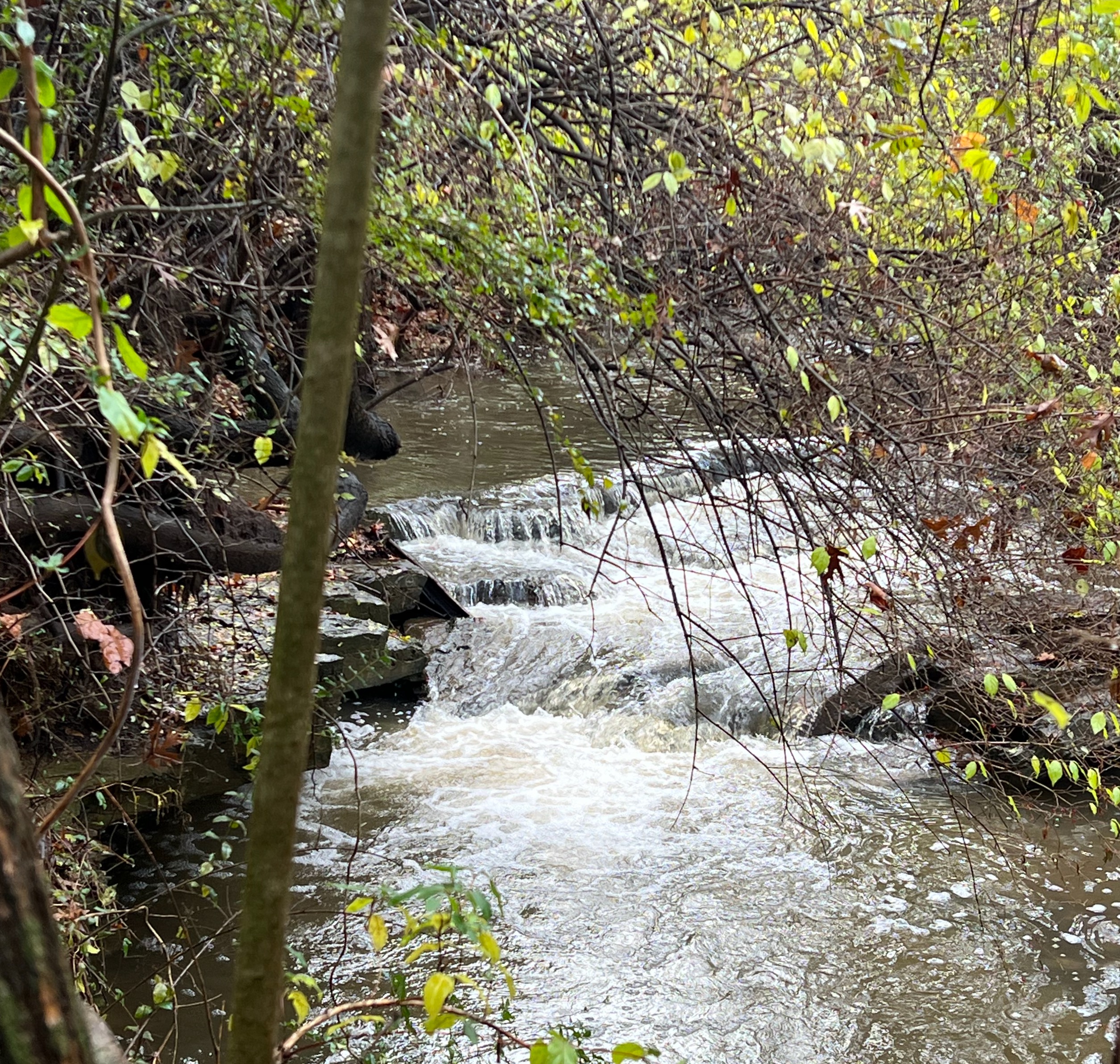
We had about an inch and a half of rain last night here in northwest Arkansas. After breakfast I walked down to the south end of our property to visit our natural neighbor, Scull Creek and its enchanting waterfall. I sometimes talk to streams, trees, critters and other fellow earthlings. I don’t know if they hear or understand me in any way, but I enjoy it, and they speak to me in their own ways.
I’ve had an idea for years that it might be an illuminating adventure to travel down the creek all the way to the Gulf of Mexico, and then back up the Vermilion River/Bayou to my birthplace of Lafayette Louisiana. I muse about how rivers, rain, streams, oceans, and all forms of water connect the world. Somehow that lets me feel more at home. I’m thinking about actually testing the water, so to speak, and find out a bit more about how feasible it would be to conduct such a journey. I’m thinking I could do some test runs on different stretches of the water between here and the Arkansas River, and then perhaps on the Arkansas River to get a feel for it.
I’ll keep you posted if this flows anywhere. If you have ideas, suggestions, questions, etc. about this, please let me know.
Old Dog’s Ditty (Bare bones version)Old dog’s on the deck: Dave with Daimin on the furry one’s last day above ground, September 15, 2008.
I wrote this song back in Hawaii for our friends’ old dog Vember (born in November), who was on his last legs back in the late 1980’s. A couple decades later, I started thinking of myself and all of us aging humans as somewhat like old dogs. This came to me after looking in the mirror and actually noticing all the wrinkles, spots, sags and such. Then it came to me that with most of our beloved pets, we still love them even if they start slowing down, having accidents, and otherwise losing their youthful exuberance. So I started calling myself “Old Dog Dave” when I need a little consolation for the various aches, pains, and other downhill sliding. It usually makes me smile.
Here’s a link to the chords and lyrics, in case you want to sing and/or play along. It follows the “3 chords and the truth” formula for a folk song. I tried to paste those here, but it goofed up the location of the chords.
This showed up today in the New Yorker daily newsletter I get for free. I like the cartoons.




 What's So What?